
Tous les articles par Laurent Lescop

Laurent Lescop Architecte dplg - docteur es Sciences Enseignant ENSAN

Gaussian Splatting: A High-Quality 3D Scene Representation

Creating a Gaussian Splatting workflow

Gaussian Splatting is a novel 3D scene representation technique that’s revolutionizing novel view synthesis (creating new camera viewpoints of 3D scenes). It emerged as a state-of-the-art alternative to Neural Radiance Fields (NeRFs) in 2023.

Core Concept

Instead of representing scenes with neural networks (like NeRFs) or explicit meshes, Gaussian Splatting represents scenes as millions of tiny 3D Gaussian « blobs » that can be efficiently rendered using a technique called « splatting. »

The technique represents a significant shift from implicit neural representations back toward explicit, differentiable graphics primitives, but with modern optimization techniques that achieve unprecedented quality and speed.
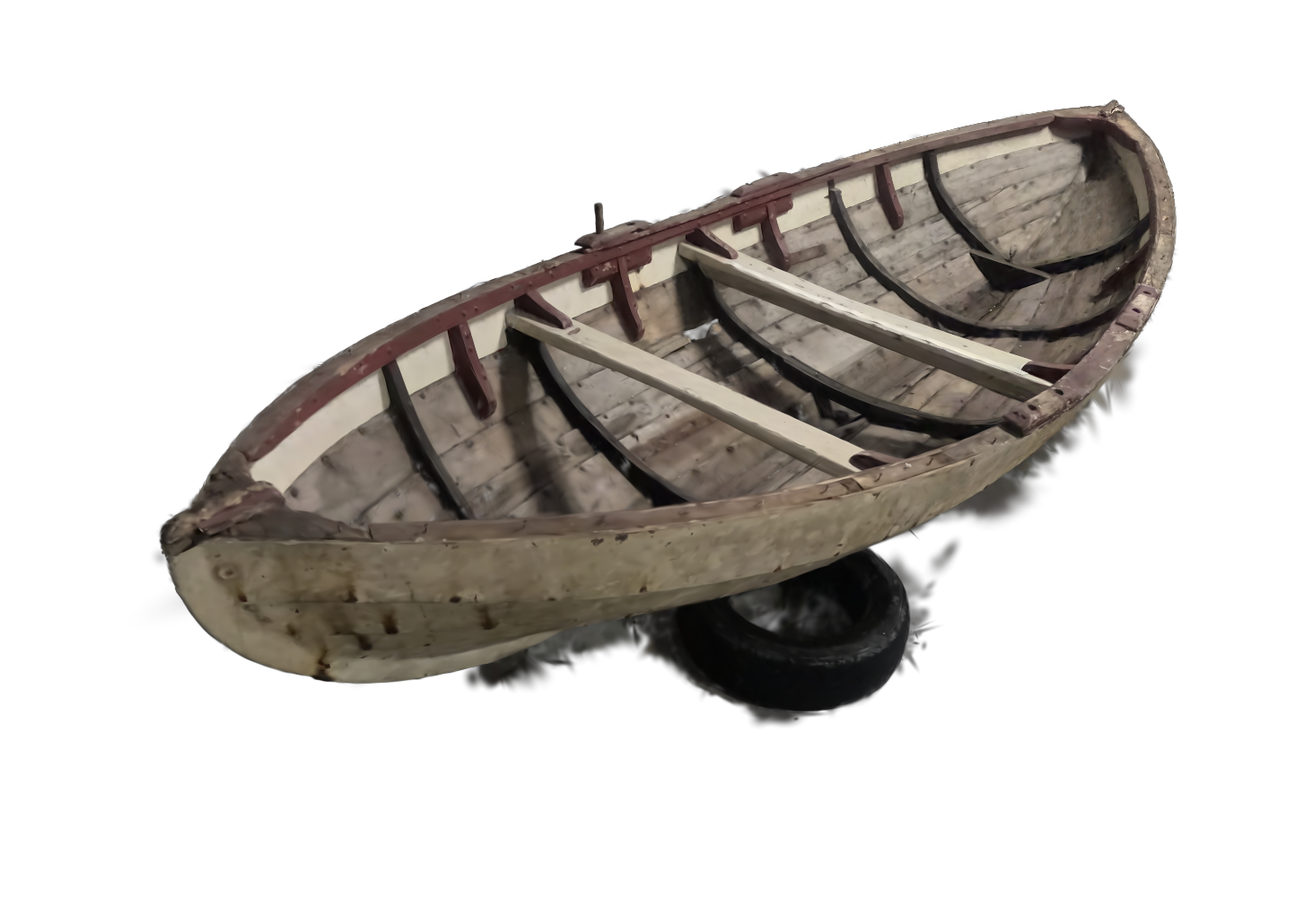
D:\LAURENT\Downloads\splat-image (5).png

Step one

Choosing the platform : NerfStudio https://docs.nerf.studio/

Nerfstudio: A Framework for Neural Radiance Field (NeRF) Development

Nerfstudio is an open-source, modular framework designed to make Neural Radiance Field (NeRF) research and development more accessible, organized, and collaborative. Think of it as « PyTorch Lightning for NeRFs » or « Hugging Face for 3D reconstruction. »

Training is working as this:

  • ns-train nerfacto –data data/processed
  • ns-train instant-ngp –data data/processed # faster
  • ns-train gaussian-splatting –data data/processed # real-time rendering

Installation: Mandatory Prerequisites

Before running the script, you must install these three tools. Without them, the script will fail 100% during compilation.

Visual Studio Build Tools (The C++ Compiler)

Download and install « Visual Studio Build Tools 2022 » (free from Microsoft).

Crucial: During installation, check the box for « Desktop Development with C++ ». This installs the MSVC compiler needed to turn code into an application.

Miniconda (The Python Manager)

Install Miniconda for Windows (Python 3.x).

Check the option « Add Miniconda to my PATH environment variable » (even if it’s red-warned, it’s simpler for automation here), or use the « Anaconda Prompt » to run the script.

Git

Install Git for Windows if not already done. Here’s the link: https://git-scm.com/download/win

Using Gemini to create a dedicated installer

A few attempts were necessary to have the final intall.bat script

Launching the process

Use Anaconda Powershell to star the process

To work from a video file the command is

ns-process-data video –data C:\Splat\test.mp4 –output-dir C:\Splat\my_project

Create the 3D

ns-train splatfacto –data C:\Splat\ my_project

Important verification (FFmpeg)

ffmpeg –version

conda install -c conda-forge ffmpeg –y

Using Gemini to create a launcher

Gemini is used to create a launcher to replace the command line by buttons.

10 attempts have been necessary to have the final version. Make your own depending on your computer.

Step 2 : computing

First choose the photo set or video.

First is copies the photos or extract photos from the video

Then the COLMAP process starts, it can take a while

COLMAP (COLMAP) is a general-purpose Structure-from-Motion (SfM) and Multi-View Stereo (MVS) pipeline. It’s the de facto standard for extracting 3D information from 2D images and is crucial for most NeRF and Gaussian Splatting workflows.

What Problem Does It Solve?

Given: A set of unordered 2D images of a scene
Produces: Camera poses + 3D point cloud + intrinsic parameters
Essentially: It figures out where each photo was taken from and what the 3D scene looks like

The Three-Stage Pipeline

Stage 1: Feature Extraction & Matching

Feature Detection

  • Extracts distinctive points (keypoints) from each image
  • Uses algorithms like SIFT (Scale-Invariant Feature Transform) or SuperPoint
  • Each keypoint has a descriptor (fingerprint) for matching

Without COLMAP (or similar SfM), NeRF and Gaussian Splatting have no idea:

  • Where the camera was for each photo
  • What the camera’s lens properties were
  • Initial 3D structure of the scene

COLMAP provides the foundational 3D understanding that neural methods then refine and complete. It’s the bridge between 2D images and 3D neural representations.

The process is computationally expensive but necessary for high-quality results. Recent advances aim to reduce this dependency (like learning SfM end-to-end), but COLMAP remains the gold standard for photogrammetry-based 3D reconstruction.

Step 2 : Then the training starts

The web interface opens

The interface allows to play with quality and duration

Gaussian Splatting Training Process (Short Version)

Training transforms a sparse 3D point cloud into millions of optimized Gaussian « blobs »:

  1. Start: Take COLMAP’s sparse point cloud (camera poses + initial points)
  2. Initialize: Convert each 3D point into a Gaussian with position, color, opacity, and initial size/orientation
  3. Iterative Optimization (repeat 7,000-30,000 times):
    • Project: « Splat » all Gaussians onto 2D image planes
    • Render: Alpha-blend them into synthetic images
    • Compare: Calculate loss vs. ground truth photos
    • Backpropagate: Update Gaussian parameters (position, color, opacity, shape)
    • Adapt: Clone Gaussians in detailed areas, prune transparent ones
  4. Result: A set of Gaussians that render photorealistic novel views at 100+ FPS

Key insight: Each Gaussian learns to represent a small patch of surface/volume, optimizing position, shape, color, and transparency to match all training views simultaneously.

The web interface shows this :

Exporting the PLY

The interface helps the export process

ns-export gaussian-splat –load-config outputs\unnamed\splatfacto\2026-01-04_132232\config.yml –output-dir exports/splat/

Editing the PLY file

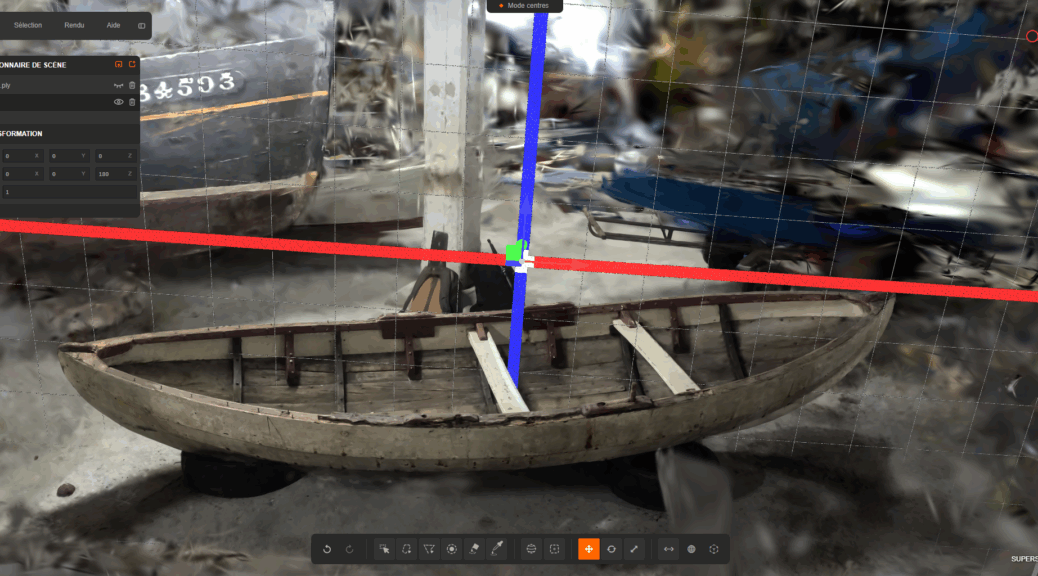
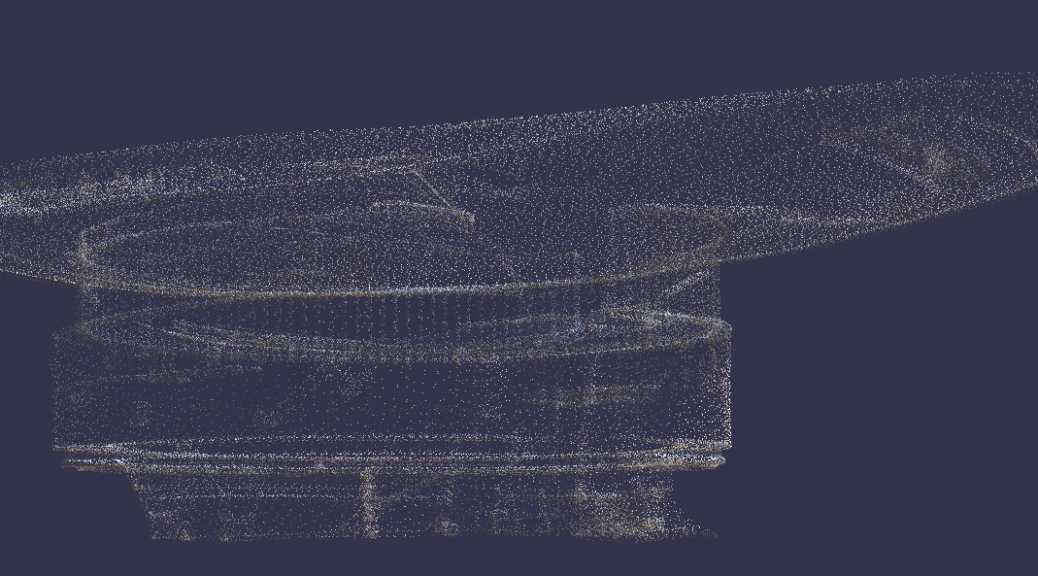
Use Supersplat editor to clean the PLY file https://superspl.at/editor

Here it’s possible to rotate, reoriente the model.

Also to render

D:\LAURENT\Downloads\splat-image (2).png

After cleaning

D:\LAURENT\Downloads\splat-image (4).png

Exporting the PLY

Visualising with https://urbandecoders-gaussiansplatviewer.netlify.app/

It’s also possible from SuperSplat to create a HTML page to visualise

IA – Prompter pour l’architecture

À l’heure où les intelligences artificielles visuelles deviennent des outils de conception à part entière, savoir formuler un prompt — c’est-à-dire décrire avec justesse une intention — devient une compétence essentielle pour les architectes et les designers.
Prompter, c’est apprendre à choisir les mots justes, à structurer sa pensée visuelle et à traduire une idée spatiale en langage opératoire.

Voici une progression méthodique : de la phrase descriptive intuitive jusqu’à la composition complexe intégrant références, styles, matériaux et mouvements.
Il s’agit moins de “parler à une machine” que de penser par les mots pour orienter précisément le résultat, explorer des variantes, et renforcer le lien entre langage, image et projet. Continuer la lecture de IA – Prompter pour l’architecture

The ribon window simulation

Before exploring and analyzing the corpus chosen for the representation of atmospheres, a simple example will be observed to measure the difficulty of the game of the representation of atmospheres in the project. This example is that of the choice that a designer could have between the strip window and the vertical window of the Renaissance type. This example has already been mentioned in the previous chapter as representative of the gap that can occur between an architectural discourse, the realization and the perception of the users. It seemed interesting to us at the beginning of the discussion on figuration to show that representation is a complex act passing through words and drawing.

Continuer la lecture de The ribon window simulation